
SUMMARY:
Benign Prostatic Hyperplasia (BPH) is noncancerous prostate enlargement that can cause urination problems by blocking the flow of urine. Moderate symptoms can be managed by medication, but if symptoms become more severe, there are minimally invasive treatments to restore normal urine flow. The Sperling Prostate Center offers two types of MRI-guided outpatient procedures so treatment can be tailored to the individual.
What is Benign Prostatic Hyperplasia (BPH)?
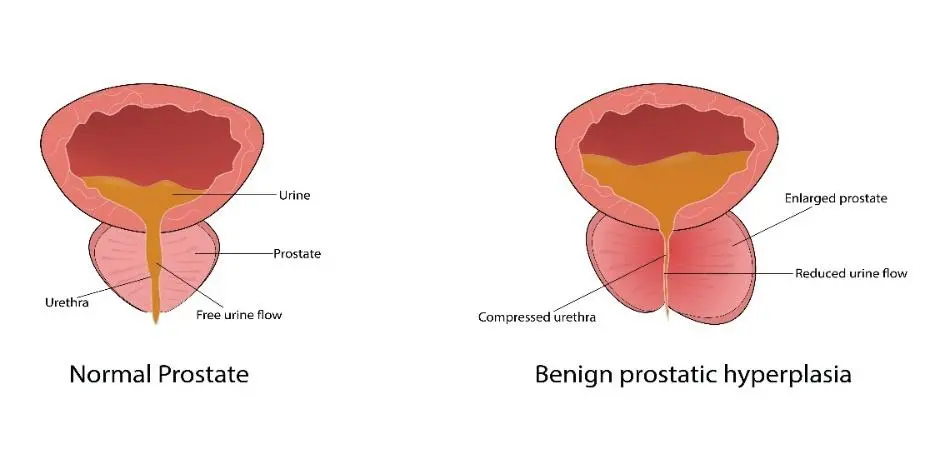
Benign Prostatic Hyperplasia (BPH) is a normal aging-related enlargement of the prostate gland. It is not a cancerous condition, though some studies have found a statistical association between BPH and an increased incidence of prostate cancer,[i] which could be the result of other factors. However, there is no biological evidence that BPH can turn into cancer. Thus, BPH does not cause prostate cancer.
As BPH enlarges the prostate, it can squeeze or block the urethra where it passes through the prostate gland. The urethra carries urine out of the bladder toward the penis, so urination problems can occur.
What are the symptoms of BPH?
According to the Mayo Clinic, common BPH symptoms include a frequent or urgent need to urinate, waking up multiple times a night to pee, a weak or interrupted urine stream, and difficulty fully emptying the bladder. If these symptoms become more persistent, quality of life suffers.
Although BPH does not cause prostate cancer, there is an overlap of symptoms between the two conditions. Therefore, when symptoms appear it is important to see a doctor for an accurate diagnosis of what is causing them.
What are the treatments for BPH?
Treatments for BPH fall into four categories:
- For mild symptoms, watchful waiting means no immediate interventions. Simply monitor symptom progression.
- For moderate symptoms, prescription medications can manage symptoms.
- For more difficult symptoms, minimally invasive treatments can reduce compression on the urethra and enlarge the passage for urine, thereby restoring normal flow.
- For severe symptoms, major surgery may be needed.
What are the most common minimally invasive treatments and how do they work?
There are two basic minimally invasive approaches: a) intra-urethral treatments are applied through the penis into the urethra, and widen the urine passage from inside by removing tissue from the urethral lining, which then heals; b) extra-urethral treatments are applied from outside the urethra to shrink the tissue that is pressing on the urethra; the treated area then becomes small harmless scar tissue while the urethra naturally widens.
Common intra-urethral treatments include TULSA, Aquablation, Rez?m, UroLift, TURP, and laser surgery. Common extra-urethral treatments include Focal Laser Ablation (FLA), Transperineal Laser Ablation (TPLA) and Prostate Artery Embolization (PAE).
To put it simply, intra-urethral procedures “carve out” the urethral lining to allow a wider passage from the inside, whereas extra-urethral procedures reduce the burden of tissue outside the urethra to allow the passage to open naturally without damaging the urethral lining.
Which approach does the Sperling Prostate Center offer?
As outpatient procedures, the Sperling Prostate Center offers both intra-urethral and extra-urethral approaches. Either approach offers equivalent relief of BPH symptoms with minimal-to-no risk of urinary or sexual side effects.
For intra-urethral widening of the urethra, the Center offers TULSA, which uses focused ultrasound to remove tissue from the urethra lining. TULSA is directed through the penis into the prostate urethra, and is guided by real-time MRI. TULSA is performed under IV sedation.
For extra-urethral widening of the urethra, the Center offers both FLA and TPLA. FLA involves insertion of a laser fiber through the rectal wall into the prostate, whereas TPLA involves fiber insertion through the perineum (outer skin between the scrotum and anus). Local anesthesia is used, along with oral sedatives for patient comfort. Both procedures are guided by real-time MRI.
Note that real-time MRI guidance not only assures accurate prostate mapping and targeting, but special software also tracks the heat effect in real time, and confirms treatment success immediately afterward.
Frequently Asked Questions
Q: At what age does BPH start?
A: BPH symptoms are rare in men younger than age 40. In men older than age 50, BPH is the most common prostate problem, typically beginning around that age. The National Institutes of Health reports that BPH affects 5% to 6% of men ages 40 to 64 and 29% to 33% of those ages 65 and older.
Q: Do minimally invasive BPH treatments have sexual side effects?
A: Although no minimally invasive BPH treatment is free from risk, the benefit of “providing superior symptom relief in comparison to pharmacological treatment, while minimizing the impact on sexual function”[ii] far outweighs the risk. A 2026 review of 24 studies found “improvements at 12 mo of ?50% in the International Prostate Symptom Score (IPSS) and maximum flow rate (Qmax), and of ?1 point for a quality of life (QoL) questionnaire” with impact on sexual function ranging from 0-5%. The authors concluded that minimally invasive treatments “provide effective symptom relief while preserving sexual function.”[iii]
Q: I take medication that improves my BPH symptoms. How will I know if a need a minimally invasive treatment?
A: If you currently take medication that is working for you, continue your regular checkups. However, if your symptoms get worse or more frequent, or if you think you are having medication side effects, see your doctor right away. Also, some BPH patients simply don’t want to take pills every day. In either case, discuss options with your doctor, and do your own research.
Content reviewed by Dr. Dan Sperling, M.D., DABR — updated April 2026.
NOTE: This content is solely for purposes of information and does not substitute for diagnostic or medical advice. Talk to your doctor if you are experiencing pelvic pain, or have any other health concerns or questions of a personal medical nature.
References
[i] Dai X, Fang X, Ma Y, Xianyu J. Benign Prostatic Hyperplasia and the Risk of Prostate Cancer and Bladder Cancer: A Meta-Analysis of Observational Studies. Medicine (Baltimore). 2016 May;95(18):e3493.
[ii] Franco A, Ditonno F, Manfredi C, Bologna E, Licari LC, Orecchia L, Finazzi Agró E, Antonelli A, Arlandis S, Autorino R, Tarcan T, Cornu JN, Elterman D, Kaplan S et al. Systematic Review and Pooled Analysis of Functional and Sexual Outcomes of Minimally Invasive Surgical Treatments for Benign Prostatic Obstruction. Eur Urol. 2026 Apr;89(4):318-331.
[iii] Ibid.
About Dr. Dan Sperling

Dan Sperling, MD, DABR, is a board certified radiologist who is globally recognized as a leader in multiparametric MRI for the detection and diagnosis of a range of disease conditions. As Medical Director of the Sperling Prostate Center, Sperling Medical Group and Sperling Neurosurgery Associates, he and his team are on the leading edge of significant change in medical practice. He is the co-author of the new patient book Redefining Prostate Cancer, and is a contributing author on over 25 published studies. For more information, contact the Sperling Prostate Center.