
Benign prostatic hyperplasia (BPH) is a common condition that occurs as men age. Largely due to hormonal changes after about age 50, the prostate gland can begin enlarging. It’s as if it’s “bulking up.”
Though rare before age 40, by age 50 about half of men have BPH. As men get older, the gland can continue to grow. It is estimated that by age 80, up to 90% of men are affected. Noncancerous prostate enlargement is normal. It is not life-threatening. However, many men may not even they have BPH until it causes urinary symptoms.
How does BPH cause urinary symptoms?
The passage that carries urine out of the bladder travels through the prostate on its way to the penis. This passage is called the urethra. Where it passes through the gland it is called the prostatic urethra.
As the prostate enlarges, it compresses (squeezes) the prostatic urethra, and begins blocking urine flow.
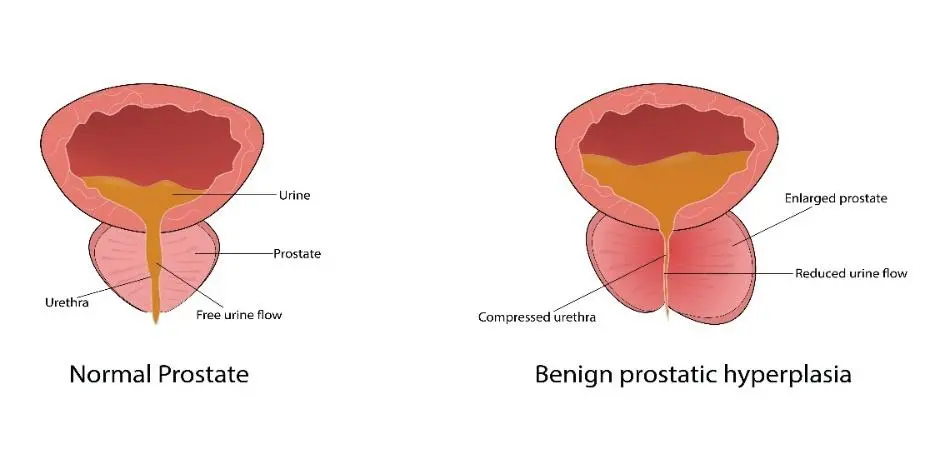
When the flow of urine is blocked, symptoms commonly occur including
- Frequent urination or frequent sense of urgency
- Increased nighttime urination that disrupts sleep
- Difficulty starting to urinate
- Inability to completely empty the bladder
- UTI (urinary tract infection)
- Kidney infection
- Bladder stones
What are treatments to stop symptoms?
There are three categories of treatments that can relieve urinary symptoms of BPH.
- Medications either relax prostate muscles to make urine flow easier, or counter the effects of hormone changes that cause prostate growth to reduce prostate size.
- Minimally invasive surgical treatments (MISTS) using slender instruments are applied through the penis into the prostatic urethra. Such procedures widen the passage either by destroying its lining (ablation using steam, called Rez?m) or implantation of a permanent device to pull tissue away from the urethra (UroLift).
- Traditional surgical procedures also access the prostatic urethra through the penis. They widen the urethra either through tissue removal (simple prostatectomy; TURP) or vaporizing away tissue using laser-generated very high heat (HoLEP laser; GreenLight laser).
Are all these treatments equally durable?
Apparently not. Some methods seem to have longer-lasting success than others. A January 2026 journal article reported an analysis of case records on over 400,000 BPH procedures performed from 2014-2024.[i] Durability at 5 years was calculated based on need to re-treat or re-initiate medication.
Traditional surgical interventions (simple prostatectomy; laser vaporization) were the most durable, with the lowest rate of re-treatment at 5 years. Re-starting medication or re-treatment was more common after minimally invasive treatment, particularly Rez?m and UroLift. Overall, the average durability of TURP fell in the middle, and it remained the most often performed procedure.
TPLA, a new approach to treating BPH
All of the above are transurethral procedures, meaning instruments are inserted into the penis to the prostatic urethra to widen it. Now there is an alternative to transurethral procedures.
It is designed to reduce prostate size around the urethra, so urine flow is gradually restored naturally. It’s called Transperineal Laser Ablation (TPLA). Instead of expanding the urethra from the inside, minimally invasive TPLA reduces bulky prostate tissue from outside the urethra. It is an image-guided focal treatment done with local anesthesia.
How is TPLA done?
A slender laser optic fiber is inserted through the skin of the perineum (skin below the scrotum) into focal areas of the prostate. The urethra the nerve bundles that control erection are not damaged during treatment. When activated, the laser destroys (not vaporizes) small focused areas of prostate tissue near the urethra. Treated tissues die and are absorbed by the body, making the gland smaller.
Clinical studies point to the promise of this treatment as a new way to relieve the urinary symptoms of BPH. For instance, a study of 100 BPH patients found that at all follow-up timepoints “both symptoms and functional parameters showed a statistically significant improvement.”[ii] (At the time of the treatment, 81% of the patients were already under treatment for BPH symptoms, and 14% even needed a catheter to empty the bladder, so the treatment proved safe and effective). During the period of the study, no retreatment was necessary.
TPLA at the Sperling Prostate Center
The Sperling Prostate Center, joined by TPLA expert Dr. Eric Walser, is proud to offer TPLA for both BPH and prostate cancer, as well as our Focal Laser Ablation for BPH and prostate cancer, and Focal TULSA. Contact us confidentially for more information.
NOTE: This content is solely for purposes of information and does not substitute for diagnostic or medical advice. Talk to your doctor if you are experiencing pelvic pain, or have any other health concerns or questions of a personal medical nature.
References
[i] Carletti F, Tamborino F, Turcan A, Santarelli V et al. Five-year Retreatment and Medication Restart Rates Following Benign Prostate Hyperplasia Treatments: A Nationwide Real-world Analysis Using Epic Cosmos. Eur Urol Focus. 2026 Jan 19:S2405-4569(26)00002-7.
[ii] Lo Re M, Polverino P, Rivetti A, Pecoraro A et al. Transperineal laser ablation (TPLA) of the prostate for benign prostatic obstruction: the first 100 patients cohort of a prospective, single-center study. World J Urol. 2024 Jul 10;42(1):402.
About Dr. Dan Sperling

Dan Sperling, MD, DABR, is a board certified radiologist who is globally recognized as a leader in multiparametric MRI for the detection and diagnosis of a range of disease conditions. As Medical Director of the Sperling Prostate Center, Sperling Medical Group and Sperling Neurosurgery Associates, he and his team are on the leading edge of significant change in medical practice. He is the co-author of the new patient book Redefining Prostate Cancer, and is a contributing author on over 25 published studies. For more information, contact the Sperling Prostate Center.