
SUMMARY:
Focal therapy or focal treatment offers a balanced middle ground between radical treatment and Active Surveillance. On one hand, it provides comparable cancer control to approaches that remove or destroy all the prostate gland; on the other hand, it preserves quality of life similar to treating none of the gland because there are minimal to no side effect risks. The Sperling Prostate Center offers several focal therapy methods in order to match the best approach with each patient’s case and personal preferences.
Is there a range of prostate cancer treatments for localized prostate cancer?
Today, there is a range of treatment choices for localized prostate cancer. At one end of the spectrum there are radical interventions, while at the other end is Active Surveillance.
How do radical interventions treat localized prostate cancer?
Radical treatments remove or destroy all of the prostate gland, including the cancer it contains.
- Radical prostatectomy is surgery to remove the entire prostate and any nearby structures suspected of containing early prostate spread (lymph nodes, seminal vesicles). Methods include open surgery, laparoscopic surgery, and robotic-assisted laparoscopic surgery.
- Radiotherapy exposes the entire prostate to radiation for a period of time. Radiation does not immediately kill cancer, but it harms the ability of cancer cells to reproduce so they eventually die off. Methods include conventional radiation, IMRT, SBRT, brachytherapy, and proton beam.
- Ablation immediately destroys the entire gland by applying lethal energy (extreme heat or cold). There are two methods that can treat the whole prostate, cryotherapy and HIFU.
How does Active Surveillance treat localized prostate cancer?
Active Surveillance for localized low-risk prostate cancer is not a treatment, but rather it is a management strategy. It is considered a safe way to hold off on any treatment or intervention because low-risk prostate cancer is unlikely to grow quickly. During Active Surveillance none of the gland is treated, thus avoiding the risks of radical treatment until it becomes necessary.
During Active Surveillance, patients are prescribed a protocol to monitor for any increase in their cancer. Monitoring consists of PSA tests, multiparametric MRI (mpMRI), and monitoring biopsies. Treatment is indicated when monitoring gives evidence of cancer growth or progression.
What are the benefits and risks at either end of the spectrum?
Each end of the treatment spectrum, all or none, has benefits but it also risks.
Radical approaches offer high cancer control rates by treating the whole gland, but they come with risks of incontinence, erectile dysfunction, or bowel problems depending on the treatment. Also, patients may have down time from their work due to surgery recovery or weeks of radiation sessions.
On the other hand, Active Surveillance offers high quality of life by treating none of the gland. This avoids the side effect risks of radical treatment, but it comes with the risk of psychological discomfort (anxiety, fear) and/or missing a treatment window.
Is there a middle ground between all or none?
Yes, there is a middle ground between radical treatment and Active Surveillance. It is called focal therapy or focal ablation. It uses minimally invasive ablation to destroy just the cancer while sparing healthy prostate tissue.
Focal therapy is a balanced middle ground between radical treatment and Active Surveillance. It offers high rates of cancer control that are comparable to those of radical treatment, but with very low risks of urinary or sexual side effects (no risk of bowel problems).
At the same time, it offers freedom from psychological discomfort because the cancer is destroyed. An added bonus is not missing a treatment window, because the cancer is already effectively treated.
How does focal therapy work?
Focal therapy works by selectively killing a localized prostate cancer lesion (tumor) without surgery or radiation. It does so by applying precisely targeted lethal energy to the lesion plus a pre-emptive margin of safety all around it. There are several different methods that can accomplish this.
Here are the most common focal energy methods in the United States:
- Focal cryotherapy destroys with extreme cold
- High intensity focused ultrasound (HIFU) destroys with extreme heat
- Focal laser ablation (FLA) destroys with extreme heat
- Transurethral ultrasound ablation (TULSA) destroys with extreme heat
- Irreversible electroporation (NanoKnife) destroys with electrical energy
Does the Sperling Prostate Center offer focal treatment?
Yes, the Sperling Prostate Center has been a leader in qualifying and treating patients using focal treatment for more than a decade. Unlike many other centers with one or two technologies, Dr. Sperling and his experienced team have been providing three FDA-approved MRI-guided methods:
- Focal laser ablation (FLA)
- Transurethral ultrasound ablation (TULSA)
- MRI-guided focused ultrasound (MRgFUS or Exablate).
In addition, the Center now also offers MRI-guided transperineal laser ablation (TPLA).
The advantage of offering several focal therapy technologies is the ability to match the treatment method to the patient’s clinical needs and lifestyle preferences. However, if a patient is not a candidate for focal therapy but requires an intervention, Dr. Sperling discusses with the patient appropriate radical treatment choices in his case.
Is it fair to say that focal treatment combines the best of two worlds?
Yes, it is fair to say that focal therapy combines the best features of radical interventions and Active Surveillance. Focal treatment balances effective cancer control at rates comparable to treating all of the gland, with maximum probability of preserving lifestyle and quality of life that comes with treating none of the gland. In short, focal therapy combines the best of two worlds.
FREQUENTLY ASKED QUESTIONS
Q: How can a patient qualify for a focal treatment?
A: It is essential to determine if a prostate cancer patient is an appropriate candidate for focal therapy. The Sperling Prostate Center uses a thorough diagnostic work-up with state-of-the-art 3T multiparametric MRI (mpMRI) and other tests as needed. Qualified candidates have an MRI-visible index lesion (tumor) containing significant prostate cancer that is biopsy-proven to be low-to-favorable-intermediate risk prostate cancer. It is most important that the patient’s tumor be localized, that is, still contained in the gland. These are important clinical considerations. In addition, the patient must fully comply with the monitoring protocol after treatment.
Q: Why is it necessary to monitor after the treatment?
A: That is a good question. While the focal treatment itself successfully destroys the tumor plus an extra margin of safety, there is a possibility that microscopic cancer cells exist in the untreated portion of the gland. If such cells exist, and begin to form a tumor, a simple PSA blood test will detect an increase in prostate activity. If so, a repeat mpMRI can detect a suspicious lesion, and an in-bore targeted biopsy with a minimum number of needles can diagnose if significant prostate cancer is present.
Q: If prostate cancer comes back after focal therapy, what are the options?
A: One of the greatest advantages of focal therapy is that it does not close off future treatment options. If cancer returns and is still localized, the full treatment spectrum is available, from radical treatment to a repeat focal treatment to Active Surveillance. This is an aspect that patients appreciate, since options are very limited if cancer comes back after radical treatments.
Q: Does insurance cover focal therapy?
A: Focal therapy is not covered by all insurance carriers. Also, many private practice centers do not participate with insurance. In some situations, focal therapy may be covered all or in part by insurance. Check with your provider and your insurance company.
NOTE: This content is solely for purposes of information and does not substitute for diagnostic or medical advice. Talk to your doctor if you are experiencing pelvic pain, or have any other health concerns or questions of a personal medical nature.
About Dr. Dan Sperling
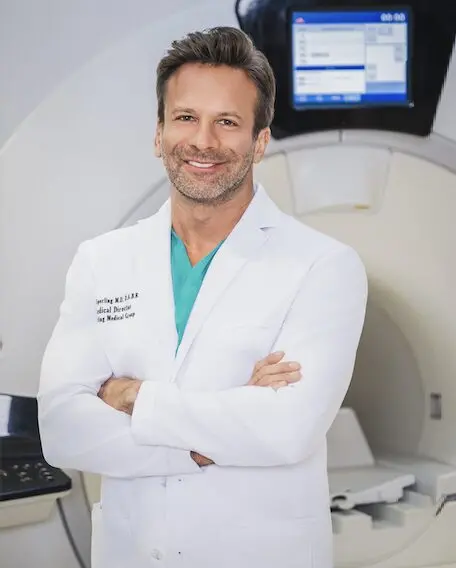
Dan Sperling, MD, DABR, is a board certified radiologist who is globally recognized as a leader in multiparametric MRI for the detection and diagnosis of a range of disease conditions. As Medical Director of the Sperling Prostate Center, Sperling Medical Group and Sperling Neurosurgery Associates, he and his team are on the leading edge of significant change in medical practice. He is the co-author of the new patient book Redefining Prostate Cancer, and is a contributing author on over 25 published studies. For more information, contact the Sperling Prostate Center.