
If you just had a high PSA test, you have a lot on your mind:
- What if I have prostate cancer (PCa)?
- Do I need a biopsy? I heard there are risks and how will I know it’s accurate?
- If it turns out I have PCa, how will I know the best treatment?
These are worrisome questions.
However, Artificial Intelligence offers reassurance. AI models are showing excellent results—comparable to, and even exceeding, the performance of human radiologists. Here are five ways in which AI is boosting patient confidence and helping to minimize worries, particularly when a suspicious PSA test is followed by a 3T multiparametric MRI (mpMRI) scan before rushing to biopsy.
- Better MRI accuracy – When images from prostate MRIs are submitted to AI models, it can “match or exceed expert performance while improving workflow.”[i] Not only can AI flag suspicious areas, it can often distinguish insignificant PCa from significant PCa. This means many patients can avoid a biopsy if AI does not detect significant disease.
- Outperforms urologists using micro-ultrasonography – When an AI program is “trained” using hundreds or even thousands of slides, it can tell the difference between cancer vs. noncancer better than urologists using micro-ultrasound, thus avoiding a reading error called false positive.[ii]
- Consistently reliable reading – Radiologic readers vary in experience, so even though there are standardized scoring systems like PI-RADS, patients who submit their MRI scans for second opinions sometimes get different interpretations between the first and second reader—how can the patient know which one to trust? AI increasingly assures the consistency and reproducibility of interpretation.[iii]
- AI collaboration with radiologists lowers stress and fatigue – The final decision on image interpretation is made by the radiologist who reviews the AI results. What many patients don’t realize is the pressure that builds up on a radiologist trying to review and report their interpretations on many MRIs in a normal workday, especially since prostate MRI has become a new standard of care to determine if a biopsy is needed. Since AI is far faster and picks up details missed by the human eye, it is already “improving radiologist performance while also reducing physician workload, minimizing burnout, and enhancing the quality of patient care.”[iv]
- Informed treatment decisions – When AI has been integrated into identifying the accurate nature of a patient’s disease, it has demonstrated success “in detecting and grading PCa, predicting patient outcomes, and identifying molecular subtypes.”[v] In turn, this guides treatment recommendations. For the patient, this minimizes the burden of anxiety and worry, boosting confidence in his physician and comfort with his choice.
Studies have repeatedly shown that patients do best, and enjoy the highest post-treatment quality of life, when they feel good about their treatment. In the world of prostate cancer, today’s AI plays a key role not just in the short-term decision-making process, but in the patient’s long-term satisfaction and freedom from worry.
Dr. Sperling himself has participated in AI applied to prostate MRI, and his contributions to team development are published. AI is already fulfilling its promise to benefit patients greatly.
NOTE: This content is solely for purposes of information and does not substitute for diagnostic or medical advice. Talk to your doctor if you are experiencing pelvic pain, or have any other health concerns or questions of a personal medical nature.
References
[i] Zhang X, Xiao N, Liang H, Li P et al. Artificial intelligence-driven prostate cancer diagnosis: Enhancing accuracy and personalizing patient care. Urol Oncol. 2026 Mar;44(3):110959.
[ii] Zhou SR, Zhang L, Choi MH, Vesal S et al. ProMUS-NET: Artificial intelligence detects more prostate cancer than urologists on micro-ultrasonography. BJU Int. 2025 Dec;136(6):1071-1079.
[iii] Canellas R, Kohli MD, Westphalen AC. The Evidence for Using Artificial Intelligence to Enhance Prostate Cancer MR Imaging. Curr Oncol Rep. 2023 Apr;25(4):243-250.
[iv] Cacciamani GE, Sanford DI, Chu TN, Kaneko M et al. Is Artificial Intelligence Replacing Our Radiology Stars? Not Yet! Eur Urol Open Sci. 2022 Dec 19;48:14-16.
[v] Zhu L, Pan J, Mou W, Deng L et al. Harnessing artificial intelligence for prostate cancer management. Cell Rep Med. 2024 Apr 16;5(4):101506.
About Dr. Dan Sperling
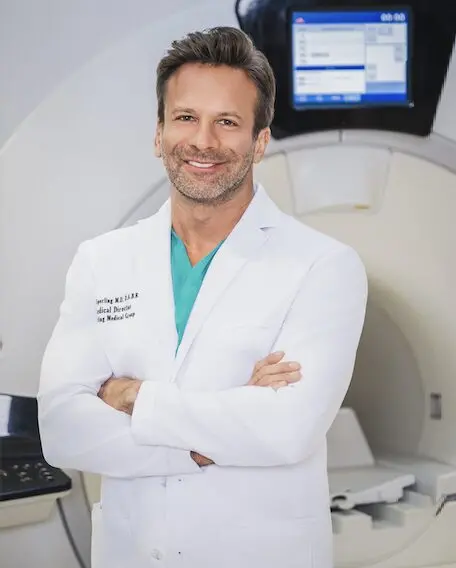
Dan Sperling, MD, DABR, is a board-certified radiologist and founder and Medical Director of the Sperling Prostate Center. He specializes in advanced multiparametric MRI, prostate cancer detection and diagnosis, and MRI-guided focal treatments. A pioneer in MRI-guided Focal Ablation Treatment, Dr. Sperling has contributed to more than 25 published studies and co-authored Redefining Prostate Cancer. His approach emphasizes diagnostic accuracy, personalized treatment, and preservation of quality of life.