
SUMMARY:
Salvage focal ablation is a potentially curative treatment for localized prostate cancer that returns after radiation therapy. Unlike conventional salvage treatments that target the entire prostate gland, focal ablation destroys only the recurrent tumor while preserving more healthy tissue. Recent studies report encouraging cancer control outcomes, fewer complications, and preservation of urinary continence. MRI and biopsy help identify patients who may qualify for this treatment.
What is radiation recurrent prostate cancer?
Primary (first line) radiation is a treatment option for localized prostate cancer. It is not uncommon, however, for prostate cancer to recur (come back) after primary radiation. It is commonly called radiorecurrent prostate cancer or primary radiation failure. Biochemical recurrence (rising PSA) rates within 5 years are estimated at 30-50%.[i] If diagnosis is positive for cancer, treatment is required.
What are the treatment options after radiation failure?
If the recurrence is localized—that is, is still contained in the gland—the only potentially curative option is salvage treatment. Salvage means a secondary treatment to remove or destroy the recurrence. It is done with curative intent. Conventional salvage treatments target the whole gland. Traditional methods include prostatectomy (surgical removal), re-radiation (beam or seed implants), cryotherapy (freezing), and HIFU (ultrasound). However, whole-gland salvage treatments have higher side effect rates.
Now there is a new potentially curative salvage approach called salvage focal ablation or salvage partial gland ablation, which has comparable cancer control but fewer side effects.
The Sperling Prostate Center specializes in focal ablation of prostate tumors, particularly focal laser ablation (laser focal therapy) for qualified patients with localized prostate cancer.
Is salvage focal ablation feasible and safe?
Yes. Two recent journal articles offer promising news about the feasibility and safety of salvage focal ablation for localized radiation-recurrent prostate cancer:
- An April 2026 publication by Light, et al. presents a comparison between salvage focal therapy and salvage prostatectomy based on 923 patients. There was no statistically significant difference in 10-year cancer-specific survival. However, salvage prostatectomy “was associated with statistically significant higher odds of any complication and major complication.”
- A May 2026 journal article by Medina, et al. reported short-term results on 51 radiation-recurrent patients who had partial gland ablation. At 2 years after ablation, 84% of patients were free of clinically significant prostate cancer, and continence was preserved in 94%.
Many radiation-recurrent patients may qualify for focal salvage therapy. As one analysis points out, “… approximately 20-40% of radio-recurrent prostate cancers are isolated and local. Recent studies have shown salvage focal treatments to have encouraging outcomes with significantly less side effects.”[ii]
What background information helps understand radiation therapy?
Primary radiation therapy is a whole-gland treatment for localized prostate cancer. It is used with curative intent for patients who can’t have or don’t want surgical gland removal (radical prostatectomy). There are two radiation approaches: a) external beam radiation and b) internal brachytherapy (seed implants). Though the delivery methods differ, they both work the same way.
How does radiation treatment affect prostate cancer cells?
Radiation disrupts the DNA in prostate cancer cells so they can’t multiply and eventually die off. Cancer cells are more vulnerable than healthy cells to DNA damage but the effect is not immediate, so radiation requires weeks of exposure (beam radiation) or permanent implants (brachytherapy seed implants).
Radiation affects normal cells as well as cancer tumor cells, but normal cells have stronger repair mechanisms. Most noncancerous cells resist die-off. However, radiation exposure may distort or compromise normal prostate anatomy.
How do you know if radiation is working?
Since radiation’s effect is gradual, imaging cannot monitor if cancer cells are dying off. Instead, repeat blood tests are done to track prostate specific antigen (PSA). PSA is a surface protein on all prostate cells, including cancer cells. Any prostate activity such as infection or cancer causes PSA to be shed into the bloodstream where it can be measured. Thus, PSA is a biomarker for suspicion of prostate cancer.
As the cancerous tumor cells die off, PSA levels begin to fall. Unlike surgical prostate removal, which causes PSA to quickly drop to an undetectable level, radiation leaves normal prostate cells in place. Normal cells continue to produce PSA. Thus, after radiation some PSA will always be detectable.
When the PSA value finally reaches its nadir (lowest point) and stays there, it is assumed that radiation has succeeded in doing its job. On average, it takes 18-30 months to reach nadir.
Does a rise in PSA after nadir mean cancer is back?
If PSA starts to rise following nadir, it’s called biochemical recurrence because a rise in PSA raises biomarker suspicion that tumor activity is back. Imaging such as multiparametric MRI (mpMRI), prostate biopsy, and other tests such as a PSMA-PET scan are done to confirm if there is a tumor, and where it is. The Sperling Prostate Center provides top-tier MRI-based diagnosis of radiorecurrent prostate cancer.
Do conventional whole-gland salvage treatments improve survival if cancer comes back?
Whole-gland salvage treatments can potentially improve survival. Average cancer-specific survival at 5 years approaches 90% or better. However, whole-gland salvage treatments have higher side effect rates than whole-gland primary treatments due to radiation-compromised prostate anatomy. Rates of severe side effects and recurrence-free survival (RFS) are roughly comparable as the table shows.[iii]
| Whole-gland salvage method | Severe urinary/sexual side effects | 2-year RFS | 5-year RFS |
| Prostatectomy | 21% | 69% | 54% |
| Cryoablation | 15% | 68% | 50% |
| HIFU | 23% | 54% | 53% |
These side effect rates help explain why salvage focal ablation is appealing.
Thus, for the right prostate cancer patient with localized radiation recurrence, focal salvage therapy is safe and feasible. If you are interested, discuss with your doctor if you may be a candidate. Contact the Sperling Prostate Center for more information.
KEY TAKEAWAYS:
- As an alternative to conventional salvage treatment, salvage focal ablation targets localized recurrent prostate cancer rather than treating the entire prostate gland.
- A 2026 study of 51 patients reported that 84% were free of clinically significant prostate cancer at two years, with urinary continence preserved in 94%.
- Multiparametric MRI (mpMRI) and prostate biopsy help identify and map recurrent tumors to determine whether a patient may qualify for salvage focal ablation.
Frequently asked questions
How do I know if I qualify?
If PSA is rising after primary radiation for localized prostate cancer, a combination of multiparametric MRI (mpMRI) and biopsy can identify patients who are potentially eligible for salvage partial gland ablation. This enables doctors to map the tumor and plan treatment. As a Memorial Sloan Kettering study concluded, “In men with recurrent prostate cancer after radiotherapy, biopsy findings and MRI can be used to select index lesions potentially amenable for [salvage partial gland ablation] …”
Does salvage focal therapy require hospitalization?
No hospitalization is required because salvage focal therapy is usually done as an MRI-guided outpatient procedure.
What does the procedure involve?
Once advanced MRI and biopsy have confirmed the diagnosis and tumor mapping, salvage focal therapy involves applying thermal energy (extreme heat or cold) to destroy the tumor and a margin of safety.
Unlike salvage prostatectomy to surgically remove the prostate, minimally invasive MRI-guided focal therapy can be done outpatient under local anesthesia. The patient lies on the MRI bed inside the bore (tunnel) of the magnet. Depending on the method (laser, cryotherapy, or HIFU) probes or ultrasound waves are targeted onto the tumor. The ablation can be monitored in real time, and confirmed by MRI after treatment.
After a recovery period at the facility, the patient gets dressed and leaves. Most patients return to normal activity within several days.
Do I need to be on hormone therapy to qualify for a salvage focal therapy?
Unless your doctor prescribes otherwise, one objective of salvage focal therapy is to avoid having to be on hormone therapy because destroying the tumor controls the cancer. Although no salvage therapy comes with guaranteed success, in most cases the effect is permanent for the patient’s lifetime.
NOTE: This content is solely for purposes of information and does not substitute for diagnostic or medical advice. Talk to your doctor if you are experiencing pelvic pain, or have any other health concerns or questions of a personal medical nature.
References
[i] Harsini S, Wilson D, Saprunoff H, Allan H et al. Outcome of patients with biochemical recurrence of prostate cancer after PSMA PET/CT-directed radiotherapy or surgery without systemic therapy. Cancer Imaging. 2023 Mar 17;23(1):27.
[ii] Haz-Hamed M, Karivedu V, Sidana A. Salvage treatment for radio-recurrent prostate cancer: a review of literature with focus on recent advancements in image-guided focal salvage therapies. Int Urol Nephrol. 2019 Jul;51(7):1101-1106.
[iii] Valle LF, Lehrer EJ, Markovic D, et al. A Systematic Review and Meta-analysis of Local Salvage Therapies After Radiotherapy for Prostate Cancer (MASTER). Eur Urol. 2021;80(3):280-292.
About Dr. Dan Sperling
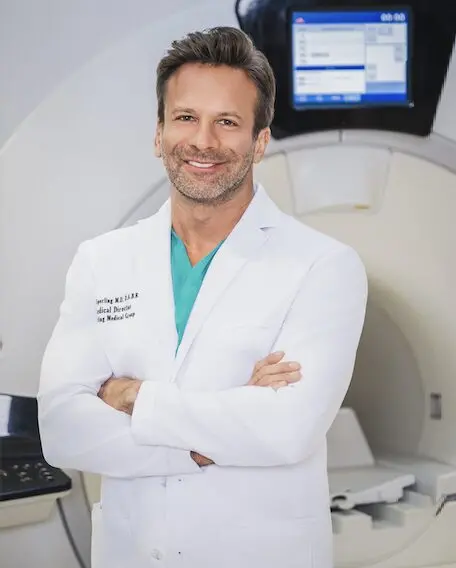
Dan Sperling, MD, DABR, is a board certified radiologist who is globally recognized as a leader in multiparametric MRI for the detection and diagnosis of a range of disease conditions. As Medical Director of the Sperling Prostate Center, Sperling Medical Group and Sperling Neurosurgery Associates, he and his team are on the leading edge of significant change in medical practice. He is the co-author of the new patient book Redefining Prostate Cancer, and is a contributing author on over 25 published studies. For more information, contact the Sperling Prostate Center.