
In joining forces with Dr. Dan Sperling, Dr. Eric Walser brings his talents as physician, professor, and researcher to the Sperling Prostate Center. If you read his profile, you know he brings impressive credentials to our Center. But there is more to Dr. Walser than accomplishments and awards.
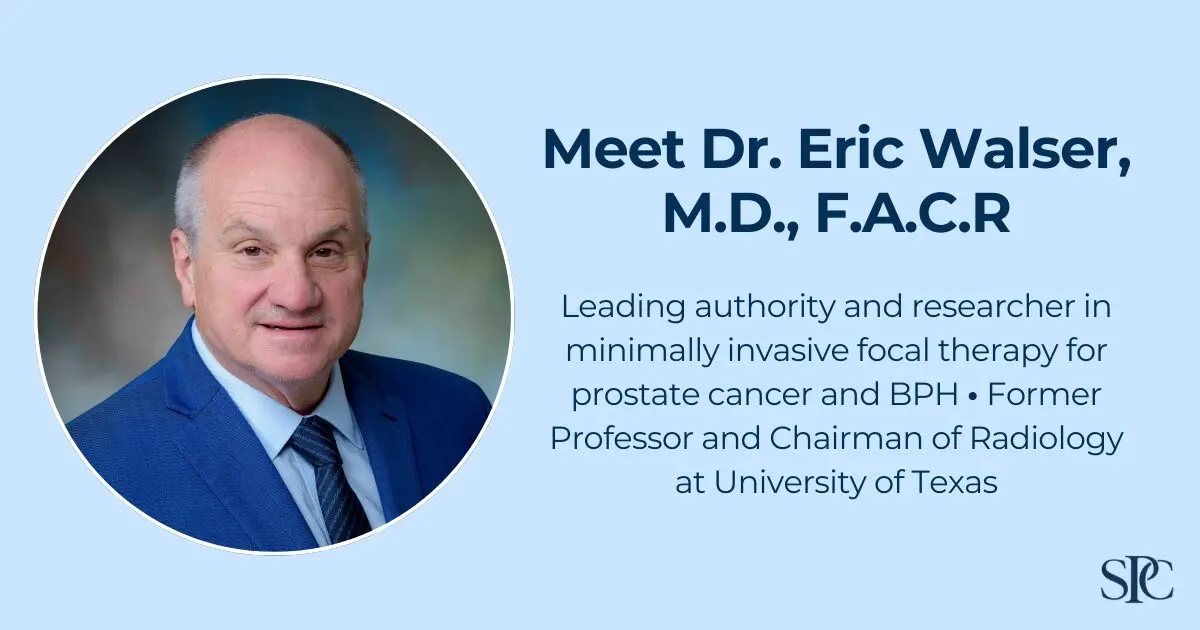
A more personal biography
To get to know him better, we asked him questions we were curious about. Why did he choose a career in medicine? What drew him to men’s prostate health? How do his patients benefit from technologic advances? Why is he leaving a successful academic career to join Sperling Prostate Center? What’s important to him in the doctor-patient relationship? Read on.
How did Dr. Walser choose a medical career path?
As he began college, Dr. Walser didn’t envision becoming a doctor. Although anatomy fascinated him, he was a bigger fan of photography. In fact, he considered a career in photojournalism. As an undergraduate at University of Texas in Austin, he worked for the school newspaper, The Daily Texan. However, he found the work time-intensive and competitive.
Then, during a summer job at a radiology practice, his routine tasks of filing X-rays and making microfilm started him on the journey to become a radiologist. He quickly realized it was a perfect blend of anatomy and photography. Leaving photojournalism behind, he transferred to Cornell University, where he graduated with a degree in Biology and a minor in Biophysics. From there he went straight into medical school, graduating with his Medical Degree (M.D.) in 1988.
During his postgraduate residency and fellowship, he found he liked interventional radiology. Having a personable nature, he preferred to interact with patients instead of spending his days in a dark room reading X-rays. He went on to teach and practice this specialty at the university level, where he especially enjoyed working with patients and mentoring young doctors.
When did men’s health, particularly prostate health, become a focus?
In 2005, he took a position at Mayo Clinic (Jacksonville, FL). Serendipity often plays a part in medical innovation, and it did for Dr. Walser. At Mayo, he met the physicist who invented the laser that Dr. Sperling uses. The inventor was looking for clinical applications for the device. Coincidentally, Dr. Walser encountered a prostate cancer patient who could not have surgery or radiation due to previous treatments for another condition. Dr. Walser saw the potential for laser. He successfully ablated the tumor, since there was no hope for a conventional treatment.
That experience was the seedling of Dr. Walser’s focus on men and their wellbeing, as well as cutting-edge technology. His vision flowered when he left Mayo Clinic and returned to academia as Department Chair and Professor of Radiology at University of Texas. As he witnessed how radiology was dramatically improving breast cancer imaging and diagnosis in women, he was convinced it could offer the same benefits for men, particularly those with prostate cancer.
Dr. Walser foresaw a future in which the imaging and diagnosis of prostate cancer would be smooth, efficient, and highly accurate. Similar to women’s experience, a man suspected of prostate cancer could go to a single center for imaging and biopsy. The same center could offer focal ablation if a qualified patient candidate chose that treatment.
How does a technically advanced approach benefit patient lives?
Dr. Walser describes how, until recently, patients diagnosed with prostate cancer faced a wall. It was either whole gland treatment or Active Surveillance, and patients accepted that. However, as word spread about the after effects of whole gland treatment, the wall began to crumble. For example, on the golf course prostatectomy patients talked to their buddies after their surgery. They admitted that they had to wear diapers, or they couldn’t get an erection anymore.
Dr. Walser states that the wall has now come down. The word is out that focal therapy is safe, with effective cancer control. It is superior as far as erectile and urinary treatment side effects. Men are benefitting because focal therapy has far less lifestyle-limiting complications. They are talking about it. They go online and blog about it or participate in online patient forums.
Dr. Walser points to two specific papers he published showing that at least in the medium-term, focal therapy’s cancer control is actually equivalent to surgery. A huge benefit is not only quality of life after treatment, but patients no longer have a wall between their diagnosis and options.
After decades in an academic setting where Dr. Walser successfully taught, did research, and treated patients, what now brings him to a community practice with Dr. Sperling?
Dr. Walser found teaching and mentoring young doctors very rewarding. The academic setting also allowed him to gather data for research purposes, which is required by companies and insurers for developing and launching new treatment technologies. These were important facets of his career, to which he still feels committed. He believes he can find ways to continue serving both aspects in his work at Sperling Prostate Center.
However, his clinical work with patients began encountering institutional limits. Though it may seem counterintuitive, he found it was becoming more difficult to offer cutting-edge procedures in an academic hospital setting. Dr. Walser attributes this frustrating situation in part to the trend toward corporate management. As corporate business norms take over, doctors increasingly have to climb over bureaucratic and financial roadblocks to do innovative procedures, which they know are in patients’ best interest with improved outcomes.
Thus, as someone who for decades has been in institutional leadership roles, Dr. Walser feels it’s time for him to step away and devote his clinical expertise to patients.
Dr. Walser has observed that innovators in medicine are shifting away from academics to centers whey they can really make change happen. He was particularly interested in joining Dr. Sperling at our Sperling Prostate Center. Since they worked together on an international panel of experts in focal laser ablation, they have been friends and collaborators. Their values and skill sets are compatible.
For Dr. Walser, working with Dr. Sperling is a golden opportunity to do more of what he likes in medical practice. He’s excited about bringing Transperineal Laser Ablation (TPLA) to our Center—something for which he encountered resistance and delays in academia. He sees working together with Dr. Sperling and our entire team as a perfect match.
What’s important to Dr. Walser in establishing a relationship with his patients?
There are many facets to the relationship between patient and doctor. A doctor’s training and technical skill are crucial, of course, but Dr. Walser emphasizes the importance of doctor-patient communication. Based on his own experience, Dr. Walser boils it down to three key factors. The first is just sitting down and having a conversation. He understands his patients want to get to know him as both a doctor and a person.
The second is keeping communication lines open, and that can become challenging because men don’t die of prostate cancer, so the number of patients in the practice grows. But it’s essential to be responsive and to have good communication structures to make access possible, whether by phone, in person, patient portals, etc.
The third is to include the patient’s significant other. Partners must be involved in the process or a main element gets lost. In many cases, it’s the partner who is driving the patient, so their involvement is crucial. In fact, Dr. Walser has seen relationships actually improve as a result of intimate conferences. Patients will openly discuss things they may not talk about with their partner, things like their ejaculation or urinary function, because these are normal physiologic and anatomic parts of life. The partner is present, the patient is relaxed and able to talk about these things when they may have been bottled up. It’s therapeutic for many couples.
In reflecting on his experience as a doctor, teacher, and researcher, Dr. Walser welcomes the opportunity to work with Dr. Sperling. Without the encumbrances of academic and corporate structures he will be able to practice medicine as he believes it should be practiced.
Still, one thing stands out for Dr. Walser. It’s all about the patients. He says it’s not their cancer that makes patients interesting. In his own words, “This journey is not one of meeting them through their cancer, but encountering them as persons.”
We look forward to Sperling Prostate Center patients encountering all that Dr. Walser adds to our practice, and getting to know him as a person.
NOTE: This content is solely for purposes of information and does not substitute for diagnostic or medical advice. Talk to your doctor if you are experiencing pelvic pain, or have any other health concerns or questions of a personal medical nature.
About Dr. Dan Sperling

Dan Sperling, MD, DABR, is a board certified radiologist who is globally recognized as a leader in multiparametric MRI for the detection and diagnosis of a range of disease conditions. As Medical Director of the Sperling Prostate Center, Sperling Medical Group and Sperling Neurosurgery Associates, he and his team are on the leading edge of significant change in medical practice. He is the co-author of the new patient book Redefining Prostate Cancer, and is a contributing author on over 25 published studies. For more information, contact the Sperling Prostate Center.