
Originally published 5/28/2015
Urologist Bert Vorstman MD continues to be “a keen observer of the state of prostate cancer.”[i] During an interview for the American Society of Clinical Oncology (ASCO), he made some observations in which he did not mince words, just as we blogged nearly 8 years ago. Here are a few examples:
- “… because of the complexity and subjectivity of the Gleason grading and scoring system, errors of interpretation and incorrect diagnoses of Gleason grades and scores are frequent. … Therefore, from a patient perspective, because a diagnosis portends invasive treatments and complications, this grading and scoring system is unreliable.”
- “…relying upon the prostate needle biopsy for detection is grossly unscientific.”
- “The best screening tool we currently have appears to be MRI. Unlike the hit-or-miss prostate needle biopsy, sampling randomly about 0.1% of the prostate, the MRI evaluates the whole prostate. And, based upon imaging details in a properly conducted study, … MRI is able to identify reliably almost all high-grade cancer anywhere within the prostate while ignoring the Gleason 6.”
- “Not all prostate MRIs are equal. Although most newer-generation MRIs are suitable, many radiologists are not skilled in prostate MRIs. Additionally, other MRI ‘detection’ options using endorectal coil MRI or office-based ‘fusion’ techniques are not reliable. The MRI images for any ‘fusion’ study are not in real-time during the ultrasound study. Worse, placement of the transrectal ultrasound can distort the shape of the prostate, making alignment with the old MRI image unreliable.”[ii]
We agree with Dr. Vorstman, and salute him for having the intestinal fortitude to tell it like it is.
In 1837, the third installment of Hans Christian Andersen’s Fairy Tales Told for Children was published in Copenhagen. It included a story about a vain emperor who is hoodwinked by a pair of tailors promising him a remarkable suit. They persuade him that the garment is made from a fabric invisible to those who are unfit for their positions. He pays them a handsome sum, and they take his measurements. When the “invisible suit” is finished, the tailors mime dressing him in it for the grand parade before his subjects. Lest the emperor declare them unfit for their jobs, everyone collaborates in the charage. Everyone, that is, except a little boy who calls it like he sees it: the emperor isn’t wearing anything!
I’m writing to bring to your attention (in case you haven’t already heard about it) a provocative report issued by Dr. Bert Vorstman , a urologist in Coral Springs, FL. It’s not the first time he has spoken out when he believes the medical public is being hoodwinked. In this case, he is highly critical of a small number of urologic experts who have been called on by the FDA to advise them in evaluating new drugs or medical devices for prostate cancer treatment. The report title he chose, “Beware, Beware FDA ‘Approved’ Robotic Prostatectomy Care” was sure to gain attention. Indeed, a press release was put out by PR Newswire at http://www.urologyweb.com/wp-content/uploads/BEWARE-BEWARD-FDA-_APPROVED_-ROBOTIC-PROSTATECTOMY-CARE-1.pdf.
In his full report[iii], Dr. Vorstman described how the FDA’s decision to approve robotic surgery for prostate cancer was based on low-level gallbladder studies. He doesn’t mince words in his energetic critique of a few urologists with vested interest in protecting robotics while exercising unethical use of “financial ties” and “influence-peddlers” to block FDA approval of novel treatment technologies. It’s important to keep in mind that the majority of urologists are patient-centered and practice medicine with integrity, and not to take everything in the report as a sweeping generalization. Even if it’s just a handful, however, Dr. Vorstman does not hesitate to call the truth as he sees it.
Dr. Vorstman decries the lack of urologic decision-making based in objective, valid and reliable evidence-based medicine (EBM) conducted according to the strictest Level I standards. Instead, he asserts that much of the “highly suspect, non-objective” studies that inform urologists’ clinical practice are based on research designed to support their own philosophies and biases. In a sweeping condemnation, he declares that the self-interested urologists’ “…endless appetite for reliance on non-EBM studies to ‘prove’ the perceived merits of their radical surgery/robotic prostatectomy treatment have long reached the point where urologists cannot separate what is true from what they wish to be true.”
Dr. Vorstman defends the FDA’s mission to protect patients by evaluating the safety and effectiveness of new drugs and technology, but bemoans the fact that some expert physicians who advise and consult to FDA investigation panels do not necessarily disclose conflicts of interest. He calls into question the “integrity, objectiveness and truthfulness” of those whose hypocrisy lies in using a robotic technology that never adequately proved its advantages in prostatectomy surgeries while ensuring that device manufacturers seeking FDA approval must run a gauntlet of approval procedures and clinical trials—only to be rejected in the end.
How does this affect patients? In my own practice, many patients over the years have said things to me like:
- The urologist said I’m still low risk so let’s just do surgery and be done with it.
- I was planning on nerve-sparing robotics but I talked to a couple of guys and found out that one of them had to use pads for 5 months and other is using injections to get erections.
- My uro said, if you don’t like the idea of surgery, I can refer you for radiation—and then it turns out it’s his group’s facility!
- I had to find you on my own. Why didn’t my doctor tell me about this?
Dr. Vorstman offers his own spin on why urologists aren’t informing patients about focal treatment, of which he is a strong supporter for appropriate candidates. He is concerned about the rampant overtreatment of insignificant prostate cancer, saying that the “healthcare public has been totally duped into thinking that robotics have been scientifically proven to be safe and effective,” and that, “In essence, many men are treated for a disease, which needs no treatment, undergo surgery with an unproven device and are often left limp and leaking.”
I, too, am concerned about overtreatment, and after perusing Dr. Vorstman’s report, I feel fortunate that the device I use for focal laser ablation is already FDA approved. I also feel lucky to be affiliated with some of the top urologists in the country, and continue to have positive collaborative experiences between radiology and urology. However, it is a sad fact of life that medicine—like every other large-scale blessing for humankind—is vulnerable to business interests and politics. I agree with Dr. Vorstman that this can only hurt patients who sometimes must go to great lengths and deal with strong opposition in seeking a consultation for a novel treatment in which they are interested.
Dr. Vorstman’s report contains a warning that regulatory oversight of patient safety is being severely compromised. The activities of protected urologic interests are undermining the interests of prostate cancer patients. In his words, “Sadly, the need to protect a surgical ‘truth’ which only urologists can see, has trumped patient safety in favor of profit.”
Seen through Dr. Vorstman’s lens, if urologic interests—or interests from any other medical specialty—are trying to become the power behind the government, the FDA can use some new tailors who make clothes using the fabric of objective science sewn with seams of integrity.
NOTE: This content is solely for purposes of information and does not substitute for diagnostic or medical advice. Talk to your doctor if you are experiencing pelvic pain, or have any other health concerns or questions of a personal medical nature.
References
[i] Robert Piana. “A Urologic Surgeon Assesses the Current State of Prostate Cancer.” ASCO Post, Nov. 25, 2020. https://ascopost.com/issues/november-25-2020/a-urologic-surgeon-assesses-the-current-state-of-prostate cancer/
[ii] Ibid.
[iii] http://www.urologyweb.com/wp-content/uploads/BEWARE-BEWARE-FDA-_APPROVED_-ROBOTIC-PROSTATECTOMY-CARE 1.pdf
About Dr. Dan Sperling
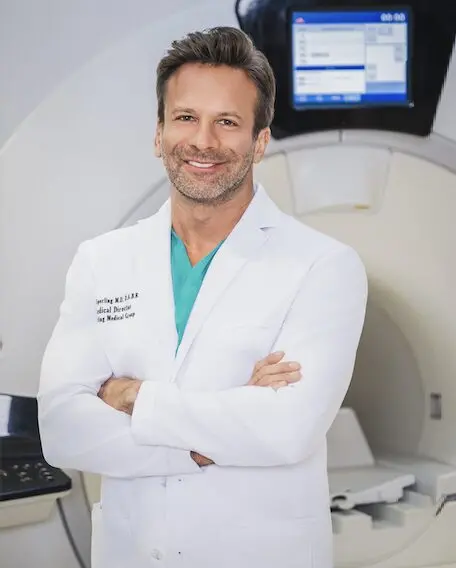
Dan Sperling, MD, DABR, is a board certified radiologist who is globally recognized as a leader in multiparametric MRI for the detection and diagnosis of a range of disease conditions. As Medical Director of the Sperling Prostate Center, Sperling Medical Group and Sperling Neurosurgery Associates, he and his team are on the leading edge of significant change in medical practice. He is the co-author of the new patient book Redefining Prostate Cancer, and is a contributing author on over 25 published studies. For more information, contact the Sperling Prostate Center.