
Originally published 8/21/2014
A well-known proverb, “The more things change, the more they stay the same,” was coined by French writer Jean-Baptiste Alphonse Karr. He might well have made the remark about Dr. Bert Vorstman’s ongoing skepticism over the conventional world of prostate cancer (PCa). Six years after we posted Dr. Vorstman’s 2014 statement that robotic prostatectomy is “a public health nightmare,” he was interviewed by the ASCO Post on the current state of prostate cancer. The force of his language had not changed. For example, he states that the significance of Gleason 6 disease has been “grossly misrepresented,” calling it “bogus Gleason 6 tumors.” Sure, there’s good evidence that Gleason 6 PCa “lacks the hallmarks of a cancer,” but labeling a long-standing urologic belief as bogus takes guts.
With regard to the conventional TRUS-guided biopsy, he describes it as “hit-or-miss”, “grossly unscientific”, and in capturing a mere 0.1% of the prostate, it leaves the doctor and patient with “zero knowledge about the remaining 99.9%.”
The more prostatectomy changes, the more Dr. Vorstman’s critique stays the same. In the same interview he insists that even when robotics became mainstream, there was still “no proof that complications were fewer nor that the procedure was safe, effective, and saved significant numbers of lives.” This leaves us with “further doubts about the usefulness of surgical treatment.”
There’s a ray of sunshine, because something has changed for the better. According to Dr. Vorstman, detecting and diagnosing PCa has improved. “The best screening tool we currently have appears to be MRI,” he declares. However, in true form as a skeptic, he points out that use of the endorectal coil or office-based fusion techniques “are not reliable.” Furthermore, he says, “Not all prostate MRIs are equal. Although most newer-generation MRIs are suitable, many radiologists are not skilled in prostate MRIs.”
We wholeheartedly agree that no endorectal coil is needed, and that fusion guidance is no substitute for real-time, in-bore MRI guidance of prostate biopsy and ablation. And, of course, we are proud to be at the forefront of experience and knowledge about prostate MRI.
As we did over six years earlier, we commend Dr. Vorstman for his fearless critique of the PCa status quo, and invite you to re-read the original blog about this urologic surgeon who faces down paper tigers.
I have never met Dr. Bert Vorstman, a urologist in Coral Springs, FL, but he sounds like a doctor who is not afraid to speak his mind. In fact, he calls robotic prostate cancer surgery “a public health nightmare” and a “boondoggle for public health.”[i] These are strong words, especially coming from a surgically-trained urologist!
Dr. Vorstman is objecting to the mass marketing of a device before there has been any scientific data to support claims of its benefits. In fact, he sees the heavy promotion of the robot as part of the tremendously misguided overdiagnosis and overtreatment of prostate cancer in men who might otherwise do just fine to delay treatment, undergo a targeted treatment, or avoid treatment altogether. Dr. Vorstman cites new thinking about Gleason 3+3 prostate cancer, which often does not behave like cancer at all in the sense that it may never become aggressive. He implies that rushing such patients to an invasive whole-gland treatment is like going after a mouse with a nuclear weapon (my words, not his).
As I perceive what Dr. Vorstman is saying, I believe his bottom line is that many physicians still approach prostate cancer with a one-size-fits-all mentality. They treat every case of prostate cancer, no matter how low grade or early stage it is, as if it must come out of the body—the sooner, the better—and they have the device to do just that! I understand Dr. Vorstman’s concern. I consider the work that I do with multiparametric MRI-guided focal laser ablation to be a valuable alternative to the kneejerk cookie-cutter approach. I can’t count the number of men over the years who have come to me for an mpMRI consultation, saying, “After my biopsy, my doctor said he could take it out and be done with it.” They are amazed when I show them the location and size of their disease, discuss whether or not it’s significant (needs treatment), and what their treatment options are—including active surveillance.
Although my style is perhaps not as forceful and public as Dr. Vorstman’s, I applaud his courage in calling out the “many unscrupulous physicians misleading men about their cancer and the debilitating robotic treatment purposefully for self-gain.” Our efforts at the Sperling Prostate Center are based in our mission to offer men options for detection, diagnosis and treatment they would not otherwise know about. I would like to think that Dr. Vorstman and I would be pleased to make each other’s acquaintance.
NOTE: This content is solely for purposes of information and does not substitute for diagnostic or medical advice. Talk to your doctor if you are experiencing pelvic pain, or have any other health concerns or questions of a personal medical nature.
References
[i] http://www.digitaljournal.com/pr/2100961
About Dr. Dan Sperling
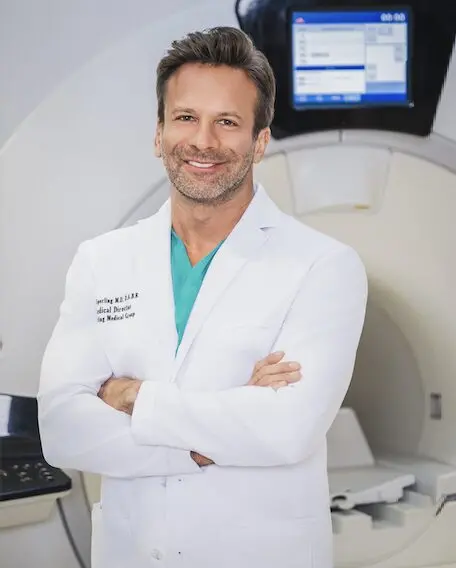
Dan Sperling, MD, DABR, is a board certified radiologist who is globally recognized as a leader in multiparametric MRI for the detection and diagnosis of a range of disease conditions. As Medical Director of the Sperling Prostate Center, Sperling Medical Group and Sperling Neurosurgery Associates, he and his team are on the leading edge of significant change in medical practice. He is the co-author of the new patient book Redefining Prostate Cancer, and is a contributing author on over 25 published studies. For more information, contact the Sperling Prostate Center.